
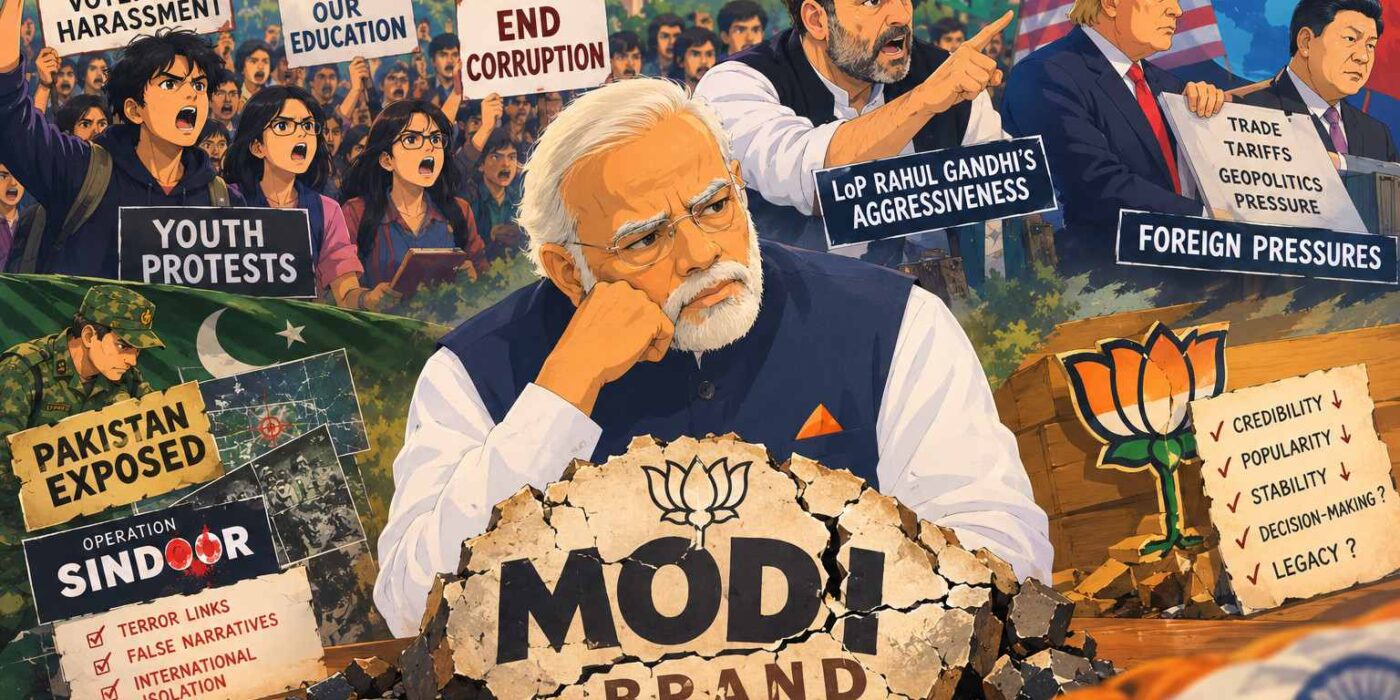
Few Indian leaders have commanded the national stage as Narendra Modi has. His victories in 2014 and 2019 gave India its most decisive mandates in three decades, the first single-party majorities since 1984. This month he marked 25 years of unbroken public service in governance, and no Indian leader since Jawaharlal Nehru has led a government for so long. “Decisive government” is his brand, and for a decade it was real, but the third term is different. The BJP’s 240 seats have turned a commanding mandate into a coalition-dependent one. Anti-incumbency is visible, the opposition has come together, and the challenges stand to the decisive-government tag is larger than at any point since 2014.
The second most serious challenge is institutional. The Election Commission’s Special Intensive Revision of the electoral rolls has removed more than 130 million names, and millions of voters are appealing to restore. The opposition alleges “vote chori” and has pressed repeatedly for Chief Election Commissioner Gyanesh Kumar’s resignation. Reports of dissent among the Election Commissioners have given the charge fresh momentum, and the demand has widened to the Prime Minister and Home Minister, whom the opposition accuses of shielding the Commissioners. Whatever, a democracy cannot run on a referee that the players distrust; And, after all, we are the ‘Mother of the Democracy’. The government’s best answer is transparency, not barricades and heavy police deployments. Credibility cannot be defended by silence.
The third challenge is on the economic front. The government has reported 7.8 percent GDP growth for the April–June quarter, but the former Finance Secretary Subhash Chandra Garg disputes it, arguing that revising last year’s base downward flattered this year’s number and that real growth is closer to 2.6 percent. Caught in a dilemma, the government states that such a comparison is statistically flawed, as it conflates two distinct data series. Whatever the truth about the numbers, the debate itself shows that public trust in government statistics is eroding. The ground reality, moreover, deepens the question: if the economy is booming, why has the rupee slid against dollar? Why have foreign investors pulled roughly ₹3 trillion rupee from the stock market this year, a record? And why is the Sensex down about 15 percent in 2026? A growth rate that puts pressure on the currency, the markets and household budgets has to be proved; it cannot be accepted as settled fact. Inflation adds to the squeeze. the RBI, too has raised the repo rate to 5.50 percent, its first hike since February 2023. SBI Research has warned that the inflation could touch 6.8 percent as early as November, with the repo rate heading toward 6 percent. In other words, when a central bank raises interest rates and warns of broadening price pressures, it plainly means the economy is not in a comfortable position.
Fourth, on the political front, Rahul Gandhi has become the most prominent face of this challenge. As Leader of the Opposition, he has put the government on the back foot with his aggressiveness, from Parliament to the streets to online platforms. Young voters, independent media and social media influencers are amplifying his questions on education, employment, inflation and corruption. A new generation of youth leaders is turning online anger into ground protest. For the first time in years, the government faces an opposition with momentum and a street presence, and for government resting on the image on a strongman narrative, being surrounded politically from every direction is a new experience. On the other hand, the coalition is also now limiting the government’s room to operate. In Bihar, Union Minister Chirag Paswan demanded the resignation of his own alliance partner Jitan Ram Manjhi and Manjhi’s son over the issue of sub-classification within reservations. Paswan says reservation is a constitutional right, not charity. In Uttar Pradesh, minister Om Prakash Rajbhar has claimed that the Prime Minister assured him the state would be divided into four after a caste census. Although there is no basis for this claim in any official process, but such episodes remind the country that the government no longer has the kind of control over its alliance as it once commanded its own benches. This is where the decisive image begins to fade. Decisiveness was always the Modi brand, yet in the third term, delays over the cabinet reshuffle, the contested delimitation bill and long-pending policy decisions have handed the opposition a new line of attack. On many policy matters the government now hesitates, and before every major step it has to bargain with its allies, its opponents and the public. In other words, the image the government built over a decade has now weakened.
Fifth, the pressure in foreign relations is no longer slight either. Relations with Nepal, Bangladesh and Myanmar have cooled, and Pakistan remains hostile. After Operation Sindoor and the US–Israel–Iran war, Islamabad’s diplomatic standing internationally has grown brighter and louder. It holds a Mecca defence pact with Saudi Arabia and Turkiye. Moreover, just last week Pakistan signed the “Badr Memorandum of Understanding” with Türkiye, Qatar and Indonesia, aimed at joint weapons production, technology sharing and defence manufacturing cooperation. These efforts have given Pakistan several new allies, access to technology and a major diplomatic platform, while India believed it had narrowed Pakistan’s options. Beyond the neighbourhood, India’s strategic space has shrunk in other regions too. China’s aggressive posture is pressing on India’s borders and markets. American tariffs and sanctions are complicating trade and our relationship with Washington. Western countries are repeatedly criticising India for financing the war in Ukraine through its purchases of Russian crude oil. Instability in the Middle East remains a separate threat to energy supplies through Strait of Hormuz and to the millions of Indians who live and work there. The Global South, which India courted as a leader, is hedging. In fact, multi-alignment works only when a country is needed by everyone, it falters when partners start to feel they can wait India out.
Taken together, these challenges describe a doctrine built for a different political era, one with a massive majority, a pliant coalition and a weak opposition. That moment has passed. The simple solution is a new regime that restores the independence of India’s institutions, reports on its economy honestly, mends relations with its neighbourhood and rebuilds the strategic autonomy that earlier generations protected. India needs decisive policy on jobs, prices and foreign affairs, not only political and religious slogans, and it needs leadership that can win back the country’s trust. Modi’s 25 years in governance certainly deserve recognition. But a legacy is judged by how, and what a leader responds when the mandate thins, and today conclusion is the Modi’s doctrine is in under pressure.
Dr. Kumar Ramesh
Deputy Registrar, Foreign Affairs Analyst and World Record Holder
