
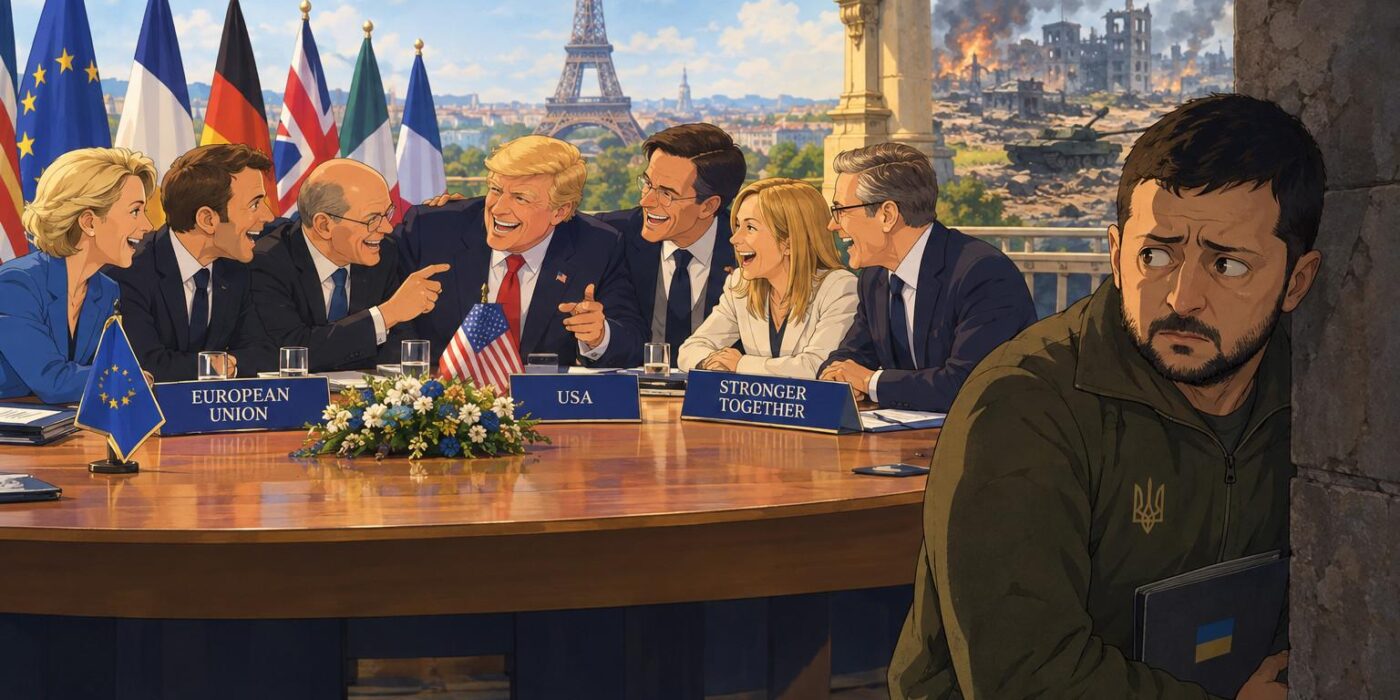
For seventy years following two devastating world wars, Europe lived by an arrangement based on the premise that US would provide security while European spent on pensions, schools, hospitals, tourism, and housing. That bargain is unraveling, and citizens are being handed the cost. While most European leaders today attribute this shift to Russia, and the threat is indeed real, yet the fear has also become a convenient pretext for redirecting public money. Billions once meant for the welfare state now flow into armaments, with voters told there is no alternative.
Europe’s vulnerability didn’t begin this year. Britain, France, the Netherlands, Spain, Russia and Japan built their prosperity on colonial empires, and their mutual rivalry ignited two catastrophic world wars. Those wars exhausted the colonial powers, while independence movements in Asia and Africa completed the process of dismantling their empires. Anti-capitalist movements that had emerged in nineteenth-century Europe converged with anti-colonial struggles, most notably in the Russian Revolution of 1917 and the Chinese Revolution of 1949. The relationship between anti-colonialism and anti-capitalism continues to evolve, both in the Global South and among former imperial powers. Consequently, although Europe lost its empires, it never resolved the question of how to remain a power without them. Nationalism kept the continent divided, and it became dependent on Washington for security; this dependency now constitutes Europe’s weakest link.
At present, America is fighting with Iran that begin in late February 2026 with US-Israeli strikes. Frustrated by Frustrated by the lack of full-scale cooperation from the NATO alliance in this conflict, Washington ordered roughly 5,000 troops out of Germany, and President Trump has threatened similar cuts in Spain and Italy. Recently, Washington’s Russia policy has swung sharply. Weeks after signing sanctions, Trump struck a big deal for Russian diesel supply, and eased restrictions for six months, prioritising midterms. When Zelensky strongly called it weak, Trump said Ukraine needs a new president. Zelensky replied that Ukrainians alone choose. Another one, A multi-billion-dollar sale of Lukoil’s overseas assets has also entered the US-Russia talks to end the Ukraine war. Putin raised it on September 5 with Steve Witkoff and Jared Kushner. The investor group includes Middle Eastern firms with ties to both negotiators’ families, though there is no evidence of personal gain. Still, when trade is discussed beside sovereignty, it is fair to ask who is bargaining for whom. The package includes refineries in the Netherlands, Bulgaria and Romania; meaning European sovereignty is on the negotiating table, even though Europe itself is not.
Undoubtedly, the danger is escalating. On September 30, Russia warned NATO that any attempt to cut off Kaliningrad could meet its entire arsenal, nuclear weapons included, and President Putin repeated this days later. NATO chief Mark Rutte replied that Putin could never defeat the alliance. Amidst these threats, France responded in kind. On October 6, first submarine-launched test of the M51.3 missile from Le Vigilant. Although the missile carried no warhead, yet this event occurring after decades illustrates the extent to which trust has eroded. Along with this, in the name of sovereignty, some politicians are plunging the world into crisis to cling to power, yet the question remains, who ultimately pays the price? The bill is now landing at the doorstep of ordinary citizens, who are struggling to meet even basic needs. Furthermore, the European Union has unveiled an €800 billion rearmament plan. Germany relaxed constitutional debt limits under its Zeitenwende. Britain cuts aid and reforms welfare, Italy raises military spending despite a barely growing economy, and even the Nordic states trim budgets. NATO’s defense benchmark is shifting from 2 percent of GDP to 5 percent. In France, the 2027 education budget rises below inflation, while debt servicing reaches €74.5 billion. A state that arrests teenagers demanding teachers while testing missiles has told its people its priorities. In Spain, parliament rejected emergency housing measures though rents nearly doubled in a decade, prompting Prime Minister Pedro Sánchez to call a snap election for November 29. Housing, education, and pensions constitute the European “good life,” yet today, all three are being deferred.
This strain belongs to a wider upheaval. From Europe to the Middle East, the global upheaval is replacing the post-1945 order with something difficult to predict. The Iran war exposed fragile global supply chains, because before the hostalities, about one third of the world’s oil passed through Strait of Hormuz and Bab el-Mandeb, and its disruption drove up energy and transport costs everywhere. Europe is already facing Trump’s unilateral tariffs and inflation, confronts rising energy costs just as budgets tighten. South Asia feels the shock through fuel, fertilizer and remittances. Yet Pakistan mediated the Washington-Tehran understanding, China facilitated Pakistan-Afghanistan talks, and Russia and India compete for influence in Kabul. This effectively dispels the old notion that global peace is determined solely in Washington and Brussels; instead, Islamabad, Doha, and Muscat have emerged as new arenas. The emerging order is characterized by multiple centers of power, specifically, ‘middle powers’ that choose their own partners. Europe learns this lesson late. On the first visit to India by a Belgian Prime Minister in two decades, Bart De Wever acknowledged that India had repeatedly warned Europe about over-reliance, and Europe had not listened. Brussels now sees India as a partner in defense, critical minerals, green energy and technology. This is prudent, yet also an admission that the continent that once ruled vast territories now seeks partnership with its former colonies.
My final argument is that Europe cannot long sustain both rearmament and its social contract amid sluggish growth, heavy debt and costly energy. Its leaders are choosing weapons and presenting the choice as a law of nature. Negotiations over a new world order are underway in Moscow, Washington, Beijing, New Delhi and Tehran. For a seat at that table, Europe needs more than missiles; functioning economies, and partners more than fickle protectors. The real question is whether security comes only from weapons, or also from schools, homes and secure livelihoods.
Dr. Kumar Ramesh
Criminologist, Foreign Affairs Analyst and World record holder
Published:
1. Central Chronicle Newspaper, 17 October 2026, Saturday, Raipur Edition, Page 10
👉🏻https://epaper.centralchronicle.in/clip/165403
